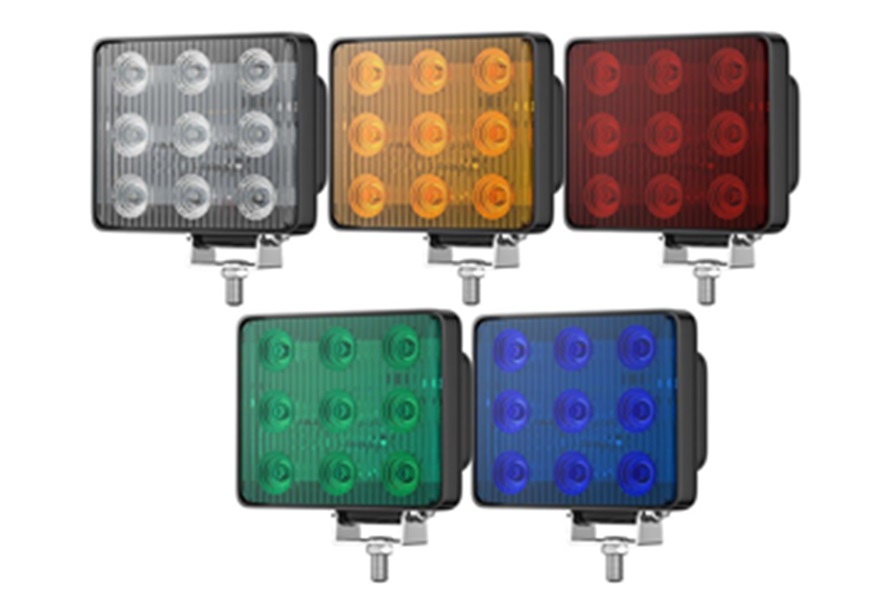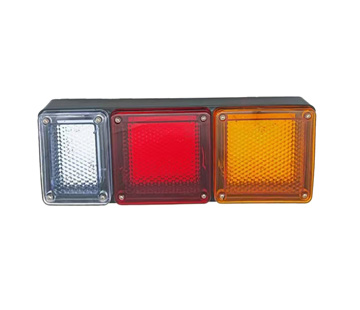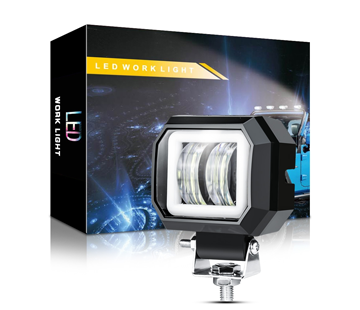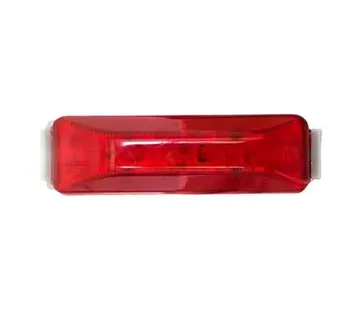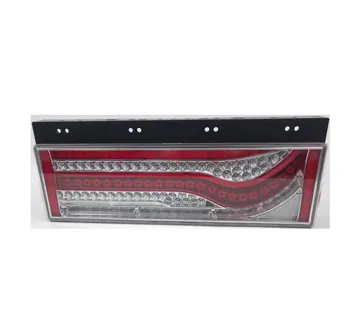
Commercial trucks must meet strict commercial vehicle lighting requirements to stay legal and safe on the road. Whether you operate fleets, sell commercial truck lighting, or source truck lights for distributors, understanding commercial vehicle lighting regulations is critical. This guide explains which lights are required on trucks, the key differences between US DOT/FMVSS 108 and European UNECE/E-mark rules, and what to consider when replacing traditional bulbs with commercial vehicle LED lights.
Commercial vehicles use multiple lamp types for visibility, signaling, and safety. Below are the most common lights and their primary purposes.
Headlights provide forward illumination for night driving and low-light conditions. They must emit white light and be mounted on the front of the vehicle.
Truck tail lights show the vehicle's rear position at night. They emit red light and must be visible from at least 500 feet.
Stop lamps activate when the driver applies the brakes. They emit red light and alert following drivers that the truck is slowing or stopping.
Turn signals indicate lane changes or turning intentions. Front turn signals are usually amber, while rear signals can be amber or red. They must flash between 60–120 times per minute.
Clearance lights indicate the vehicle's width, especially for oversized trailers. Front clearance lights are amber, and rear clearance lights are red.
Side marker lights show the vehicle's length and position from the side. Front side marker lights are amber, and rear side marker lights are red.
License plate light illuminates the rear license plate for identification. They must emit white light.
Back-up lamps signal that the vehicle is reversing and provide rear illumination. They emit white light.
Rear fog lamps improve visibility in fog, rain, or dust. They emit red light and are common in European markets.
Hazard warning lamps flash all turn signals simultaneously to indicate emergencies. Some special vehicles also use amber rotating or flashing warning lights.
In the United States, commercial vehicle lighting is governed by the Federal Motor Vehicle Safety Standard 108 (FMVSS 108) and enforced by the DOT (Department of Transportation) and FMCSA (Federal Motor Carrier Safety Administration).
Lamp Type | Color | Minimum Quantity | Mounting Position | Visibility Distance |
Headlamps | White | 2 | Front, same level, as far apart as practicable | 500 feet |
Tail Lamps | Red | 2 | Rear, same level, as far apart as practicable | 500 feet |
Stop Lamps | Red | 2 (or 1 center) | Rear, 15–72 inches from ground | 500 feet |
Turn Signals | Amber (front), Amber/Red (rear) | 2 | Rear, 15–72 inches from ground | 500 feet |
Clearance lights | Amber (front), Red (rear) | 3 (front) or 2 (rear) | 12–60 inches from ground | 500 feet |
Side marker lights | Amber (front), Red (rear) | 2 per side | 15–60 inches from ground | 500 feet |
License plate light | White | 1 | Rear, on license plate | 50 feet |
Back-up Lamp | White | 1 (or 2) | Rear | 50 feet |
Stop, turn, tail, and hazard lamps must be located on each side of the vehicle centerline, at the same height, and as far apart as practicable.
Clearance lights and reflectors must show the full width of the vehicle and be as high as practical.
Side marker lights must be at least 15 inches from the ground.
All lamps must be visible and not obscured by the tailboard, load, dirt, or equipment.
Blinking signal lights must flash between 60–120 times per minute.
The DOT requires annual lighting system inspections for heavy duty truck lights on commercial vehicles over 10,000 pounds.
Every light and reflector must be fully operational and meet color and positioning requirements to achieve the best CSA score.
Conspicuity material (red/white reflective tape) is required on semi-tractors and semi-trailers, but not on straight trucks.
Trailers equipped with proper conspicuity material may not need reflex reflectors.
In Europe, commercial vehicle lighting follows UNECE (United Nations Economic Commission for Europe) regulations, with E-mark certification confirming compliance.
UNECE Regulation 48 covers lamp installation, while individual regulations define performance for specific lamps:
UNECE R48: Installation of lamps and light-signalling devices
UNECE R7: Front position lamps (tail lamps)
UNECE R6: Rear position lamps
UNECE R23: Turn signal lamps
UNECE R3: Stop lamps
UNECE R65: Special warning lamps
Lamp Type | Color (Europe) | Notes |
Front Position Lamps | White | Same as U.S. headlights |
Rear Position Lamps | Red | Same as U.S. truck tail lights |
Stop Lamps | Red | Class I, II, or III depending on vehicle |
Turn Signals | Amber | Both front and rear |
Clearance lights | Amber (front), Red (rear) | Similar to U.S. |
Side marker lights | Amber (front), Red (rear) | Required on most commercial vehicles |
Rear Fog Lamps | Red | Common in Europe, optional in U.S. |
E-mark certification confirms that commercial vehicle LED lights meet UNECE standards.
The mark includes an "E" number indicating the country of certification (e.g., E1 for Germany, E4 for Netherlands).
Products without E-mark may be rejected at customs or during road inspections in European markets.
Turn signals must flash between 60–120 times per minute, similar to U.S. rules.
Lamps must be visible from specific angles defined in UNECE R48.
Different lamps have specific color, height, and visibility requirements to ensure proper signaling and safety.
White: Headlights, license plate light, back-up lamps, front clearance lights
Red: Truck tail lights, stop lamps, rear clearance lights, rear side marker lights, rear fog lamps
Amber: Front turn signals, front side marker lights, hazard/warning lights
Height: Most rear lamps (stop, turn, tail) must be 15–72 inches from the ground.
Width: Lamps must be on each side of the vehicle centerline, as far apart as practicable.
Clearance: Clearance lights must show the full width of the vehicle and be as high as practical.
Lamps must be visible from specific horizontal and vertical angles defined in FMVSS 108 and UNECE R48.
For example, truck tail lights must be visible from at least 45 degrees left and right of the vehicle's centerline.
Replacing traditional bulbs with LED truck lights offers better brightness and longevity, but buyers must ensure compliance with local regulations.
LED truck lights must emit the correct color (white, red, or amber) as required by FMVSS 108 or UNECE.
Some LED bulbs may emit incorrect wavelengths (e.g., red LED used as amber turn signal), which is non-compliant.
LED headlamps must meet minimum luminous intensity requirements.
Beam patterns must not cause excessive glare for other drivers.
In the U.S., LED truck lights should be DOT-certified and comply with FMVSS 108.
In Europe, LED truck lights must have E-mark certification per UNECE regulations.
Always request certification documents (CE, E-mark, DOT) from a reliable truck light manufacturer.
LED lights draw less current than traditional bulbs, which may trigger warning lights on some vehicles.
Proper wiring, resistors, or CAN bus modules may be needed to ensure compatibility.
Non-compliant heavy duty truck lights can lead to:
Customs rejection
Road inspection fines
Warranty claims
Safety incidents
Always verify that truck lights are certified for your target market before installation.
DOT follows U.S. FMVSS 108 standards.
E-mark follows European UNECE regulations.
Products must be certified for the target market.
Turn signals must flash between 60–120 times per minute in both U.S. and European markets.
Rear fog lamps are common in Europe but optional in the U.S.
Stop and turn signal lamps must be mounted 15–72 inches from the ground, depending on vehicle size.
The DOT requires annual lighting system inspections for heavy duty truck lights on commercial vehicles over 10,000 pounds.
Understanding commercial vehicle lighting regulations is essential for fleet operators, truck lights distributors, and commercial vehicle LED lights suppliers. In the U.S., follow FMVSS 108 and DOT requirements. In Europe, comply with UNECE regulations and ensure E-mark certification. When replacing traditional bulbs with LED truck lights, verify color, intensity, certification, and wiring compatibility. Non-compliant products can lead to fines, customs rejection, and safety risks. For B2B buyers, sourcing certified commercial truck lighting from a reliable truck light manufacturer like hongyuan ensures legal compliance, market access, and long-term business success. Always request certification documents, test reports, and compliance guarantees before purchasing.
 English
 العربية
 русский